
Ebook Exit, Voice, and Loyalty: Responses to Decline in Firms, Organizations, and States
How many times we should claim that publication and analysis is essential for individuals living? The book presence is not only for the bought or even provided stacked of documents. This is an extremely precious point that can change people living to be better. Also you are constantly asked to review a book and also check out again, you will certainly really feel so hard when told to do it. Yeah, many people additionally really feel that. Really feel that it will certainly be so dull to review books, from elementary to grownups.
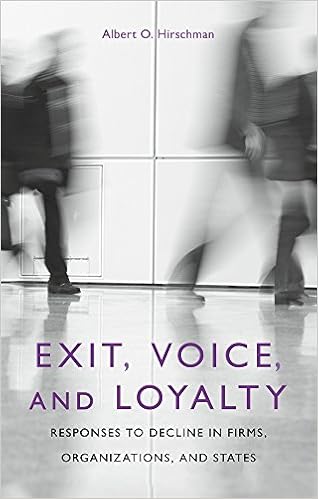
Exit, Voice, and Loyalty: Responses to Decline in Firms, Organizations, and States

Ebook Exit, Voice, and Loyalty: Responses to Decline in Firms, Organizations, and States
Do you believe that reading is an essential activity? Locate your factors why including is vital. Reviewing a book Exit, Voice, And Loyalty: Responses To Decline In Firms, Organizations, And States is one component of satisfying tasks that will certainly make your life top quality a lot better. It is not regarding simply what kind of publication Exit, Voice, And Loyalty: Responses To Decline In Firms, Organizations, And States you read, it is not simply concerning how many books you review, it's concerning the routine. Reading behavior will be a method to make publication Exit, Voice, And Loyalty: Responses To Decline In Firms, Organizations, And States as her or his buddy. It will certainly no concern if they invest cash as well as invest even more e-books to finish reading, so does this book Exit, Voice, And Loyalty: Responses To Decline In Firms, Organizations, And States
Well, currently let's see just how the book will be presented for you. Exit, Voice, And Loyalty: Responses To Decline In Firms, Organizations, And States is the one that can affect you to have better time to unwind. So, what you get in the free time is not only relaxing yet likewise much more expertise. Understanding as well as experience are very worthy as well as they will be timeless. The visibility of this book could sustain you to have that classic well worth. Extremely precious as well as valuable are just what you can also acquire from reading this book.
Never mind! Currently, in this modern era, you could get guides from many sources. No should go to the book stores as well as walking around the city, you could discover book. Below is the website that includes all outstanding publications to accumulate. You could get it in the soft documents and use it to check out. Obviously, your tab as well as computer system becomes great device to conserve the book. Exit, Voice, And Loyalty: Responses To Decline In Firms, Organizations, And States is the most effective suggestion to accompany you in this time. It will aid you accompanying the spare time while vacations.
Yeah, checking out an e-book Exit, Voice, And Loyalty: Responses To Decline In Firms, Organizations, And States could add your buddies lists. This is one of the formulas for you to be effective. As recognized, success does not imply that you have fantastic things. Comprehending as well as knowing more than various other will certainly offer each success. Close to, the message and perception of this Exit, Voice, And Loyalty: Responses To Decline In Firms, Organizations, And States could be taken as well as picked to act.
Review
“Hirschman’s work changes how you see the world. It illuminates yesterday, today, and tomorrow… His most important [book].â€â€•Cass R. Sunstein, New York Review of Books“A 126-page burst of lucidity… [Hirschman’s] masterwork.â€â€•Roger Lowenstein, Wall Street Journal“One of the masterpieces of contemporary political thought.â€â€•Malcolm Gladwell, New Yorker“This unusual and subtle book is…an exercise in interdisciplinary analysis focused on the interaction between market and non-market forces affecting the process of development and decline… Professor Hirschman develops a theory of loyalty as a key factor in the interaction between voice and exit: loyalty is shown to postpone exit and to make voice more effective through the possibility of exit.â€â€•The Economic Journal“This is an imaginative little book. Its message should be of use to economists, political scientists, and all those interested in policy questions related to these areas. Hirschman starts his argument by assuming that in time all organizations (firms, bureaus, political parties, governments, and so on) develop slack and experience a deterioration in the quality of their output. The clients of a declining organization have two options for reversing this trend: exit and voice. And much of the book is devoted to an explication of the ways in which these options operate, their relative advantages and weaknesses, the interdependence between them… It is in these discussions of current problems and institutions, however, that I find the book most rewarding. His basic point, that there exists a symbiosis between exit and voice, is certainly valid and significant. Its importance gets driven home by the way Hirschman applies the idea to various current issues. One emerges from the book feeling he has obtained a new analytic insight into policy questions which can be applied again and again.â€â€•Dennis C. Mueller, Public Policy“Professor Hirschman’s small book is bursting with new ideas. The economist has typically assumed that dissatisfaction with an organization’s product is met by withdrawal of demand, while the political scientist thinks rather of the protests possible within the organization. Hirschman argues that both processes are at work and demonstrates beautifully by analysis and example that their interaction has surprising implications, a theory that illuminates strikingly many important economic and political phenomena of the day. The whole argument is developed with an extraordinary richness of reference to many societies and cultures.â€â€•Kenneth J. Arrow“There is, of course, no substitute for a mind as original, playful, subtle, and fresh as Hirschman’s.â€â€•Stanley Hoffmann“This is a marvelously perceptive essay which illuminates some of the most interesting economic and social questions of our time. I have read it with enormous interest and admiration, and the further pleasure that one has in being with an author who can think things through.â€â€•John Kenneth Galbraith“I read Exit, Voice, and Loyalty with absolute fascination and found that it pulled together, in organized form, many random glimmerings that I had previously understood only dimly.â€â€•Joseph Kraft
Read more
About the Author
Albert O. Hirschman was Professor of Social Science, Emeritus, at the Institute for Advanced Study in Princeton, following a career of prestigious appointments, honors, and awards. Perhaps the most widely known and admired of his many books are Exit, Voice, and Loyalty (Harvard) and The Passions and the Interests (Princeton).
Read more
Product details
Paperback: 176 pages
Publisher: Harvard University Press (1970)
Language: English
ISBN-10: 9780674276604
ISBN-13: 978-0674276604
ASIN: 0674276604
Product Dimensions:
5.2 x 0.2 x 8.2 inches
Shipping Weight: 7.2 ounces (View shipping rates and policies)
Average Customer Review:
4.4 out of 5 stars
32 customer reviews
Amazon Best Sellers Rank:
#127,291 in Books (See Top 100 in Books)
Put simply, Hirschman's work here attempts to better understand the dynamics that govern dissatisfied consumers, group members and citizens in their decisions to either leave in search of a better product, group or nation or to stay put and try to make things better ("exit" vs. "voice"). It's a fundamental social dynamic that applies to a variety of institutions (as the book's subtitle indicates), and he rather diligently builds and shares his model for considering the issues -- a model that, as other reviewers have pointed out, is still very much in use in a number of fields four decades later. The prose in this book is NOT a delight nor even always easy to read; Hirschman writes very much like an academic economist. But the ideas conveyed here are provocative and useful -- not only for students of economics and political science but for product managers, human resource managers and business leaders. If you like understanding key governing principles so that you can carry them with you into new situations AND you can get through really dry writing, this short book is more than worth your time.
This is an excellent book which raises the provoking question about the various ways one can react to a failing institution where one is a participant who has made a commitment both psychologically and politically. The author, however, does not end matter there because he sets out the various options and the circumstances which may, or may not, make an available option viable.Too often there is a tendency to abandon the failing institution to the wrong people with long term consequences that are particularly damaging in the long run. However, we are not omniscient enough to have a clear picture of the future, so we guess the costs of the fight to save the institution and bail out if we think they are too high.This should be read by any discerning person who is interested in institutional rehabilitation. .
This book's greatness is inversely related to its length. Hirschman's core insights on how to effect change in polities and firms are even more valuable in the early 21st century than when he was writing. We now have effective exit from almost every community we participate in, which means we have voice, too.
Hirschman argues that rather than operating at permanently optimal level - seeking profit maximization - firms often operate at a merely "satisfactory" level. Hirschman argues that this level of inefficiency leads to "organizational slack" in the firm. In times of strong competition, firms can draw upon this slack in order to squeeze out greater production through an investment in work hours, improved productivity, and other forms of pressure. When competition is not so fierce, firms are subject to a certain level of decline and subsequently become inefficient, i.e. they experience declining quality, high prices, etc. When firms are underperforming in this manner, customers have two options to correct this inefficiency: exit and voice. Both exit and voice are used by consumers in order to snap a firm back into efficiency. When selecting exit, customers leave the underperforming firm in favor of an alternative. When using voice, customers voice their concern directly to the firm or its managers. These two options are not mutually exclusive and may be used in tandem.Exit represents the economic side of recuperation mechanisms and often results from a decline in quality. When quality drops, customers exit and the firm's revenues fall. When management becomes aware of customer desertion, it must take an active role in repairing the damage to the firm. However, the level of response varies with the level of exit. A small number of exiting customers is unlikely to lead to corrective action by management, because the damage caused by the exit is not significant to serve as an incentive for change. The same can be said about a high number of exiting customers. If the damage is too great, no recuperation measures will be pursued as the damage is too great to recover from. However, if an intermediate number of customers exit, the management will pursue actions which may lead to a full recovery. This illustrates the need for both inert and alert customers in order for exit to work. Alert customers leave and thus provide the firm with feedback, while the inert customers grant the firm time to adjust and change. However, it must be noted that exit does not always lead to efficiency. When goods are not readily substitutable, or a decline in quality occurs across a sector, exit will not work. Those who exit will be shuffling from firm to firm across a sector. For every customer lost, the firm will simply gain a customer from a competing firm.Voice represents the political side of the recuperation mechanisms. It can be used as either a supplement or alternative to exit. The effectiveness of voice is positively related to its volume, but, like exit, it can be overdone. Like exit, a mixture of both inert and alert customers is necessary for the voice option to work. People will hold their political capital in reserve and bring a great weight to bear on the firm when they deem it necessary. However, the elites still must be allowed to make decisions. It must be noted that voice often serves in a residual role to the exit strategy. The voice option is often the only way a customer or members of a group can react when the exit option is unavailable, i.e. in churches, families, or the state. As such, "The actual level of voice feeds on inelastic demand, or on the lack of opportunity to exit" (Hirschman, 1970, p. 34). In such a case, voice carries the entire burden. However, in such cases where customers feel that voice will serve as an effective recuperation mechanism, the will postpone exit. This is true in that once a person has exited a firm, they have lost the power of voice, but not vice versa. Customers will prefer the voice option to exit when; 1. they assume the firm will return to its original superiority over substitutable alternatives; 2. they want to "do something" to change the quality, i.e. to exert influence; 2. they expect their own influence, coupled with that of others to create changes; 4. they have developed loyalty to the firm. In sum, the voice option works in markets with a limited number of buyers. Here, a group of buyers are able to influence the management of the firm. Such a trait is most often found in organizations as opposed to business firms. Additionally, we are most likely to see the voice option used when the buyer is stuck with, and dissatisfied with a product from which the customer can not readily exit.With the Exit and Voice framework established, Hirschman seeks to use the paradigm to explain a number of social phenomena. For example, Hirschman argues that "the consumer who is rather insensitive to price-increases is often likely to be highly sensitive to quality declines" (1970, p. 49). These consumers tend to be better off as they can afford changes in price. In short, if price increases but quality remains the same, the customer is likely to stay. However, if quality declines and price remains the same, these consumers will exit in favor of a higher quality, but perhaps more expensive substitutable good. As such, Hirschman hypothesizes that customers are more likely to resort to protest in regards to declining quality in high-quality goods than they are with medium of low-quality goods. Hirschman uses this hypothesis to explain the differences between upper and lower class cleavages: "the role of voice in fending off deterioration is particularly important for a number of essential services larges defining `quality of life.' Since in the case of these services, resistance to deterioration requires voice, and since voice will be more forthcoming more readily at the upper than the lower quality ranges, the cleavage between the quality of life at the top and at the middle or lower ranges tend to be more marked" (1970, p. 53).Additionally, Hirschman uses the Exit and Voice paradigm to examine monopolies, arguing that sometimes, a tight monopoly is better than a system of competition. He argues that a no-exit situation will be better than a system of competition under two circumstances; 1. "exit is ineffective as a recuperation mechanism, but does not succeed in draining from the firm or organization its more quality-conscious, alert and potentially activist members"; and 2. "if voice could be made into an effective mechanism once these customers or members are securely locked in" (1970, p. 55). This implies that in a tight monopoly, voice still holds some power. In a loose monopoly, where some competition still exists, a company is willing to loose those loud people who will choose to exit, thus ensuring that the firm will not pursue a move towards returned efficiency.Hirschman also examines the role of Exit and Voice on the two-party system. Changes in quality are interpreted differently by different people. For example, in political parties, a move towards the center will anger those in the extreme polls. Hirschman writes that the firm will tend to minimize the discontent of its customers to reduce hostility in the environment in which it operates. This implies that the market will "clear" somewhere in the middle of the two discount levels. Hirschman argues that those voters who are near the middle of the spectrum are non-captive voters, meaning that they retain the power of exit. They may defect to the other party. Those on the extreme polls, however, do not have the exit option as they are too distant from the other rival party. Hirschman refers to those in the fringes as captive voters. As such, in a dual-party system, it pays for the party to mover towards the center in the hopes of maintaining the non-captive voters, knowing that the fringe voters are relatively stuck with the situation.The main value of Hirschman's Exit and Voice framework is that is can be applied to a host of social science phenomena. Although written nearly forty years ago, scholars still take the Exit and Voice model when explaining other social problems.
This is a good book
From economics to politics, political science and psychology/sociology. A masterpiece
A classic and much needed work; an impressive guide to better understanding the nature of and dynamics related to our political nature and culture.
I am still fairly new to scholarly economics, but Exit, Voice and Loyalty has helped illuminate for me what it is I like about the NORMS of economics (the encouragement to be selective about what one does with limited time and resources) and what it is I don't (the tendency to undervalue those things in human society -- in life -- which are hard to quantify, and which aren't allocated by markets efficiently, or at all).
Exit, Voice, and Loyalty: Responses to Decline in Firms, Organizations, and States PDF
Exit, Voice, and Loyalty: Responses to Decline in Firms, Organizations, and States EPub
Exit, Voice, and Loyalty: Responses to Decline in Firms, Organizations, and States Doc
Exit, Voice, and Loyalty: Responses to Decline in Firms, Organizations, and States iBooks
Exit, Voice, and Loyalty: Responses to Decline in Firms, Organizations, and States rtf
Exit, Voice, and Loyalty: Responses to Decline in Firms, Organizations, and States Mobipocket
Exit, Voice, and Loyalty: Responses to Decline in Firms, Organizations, and States Kindle

0 komentar:
Posting Komentar